


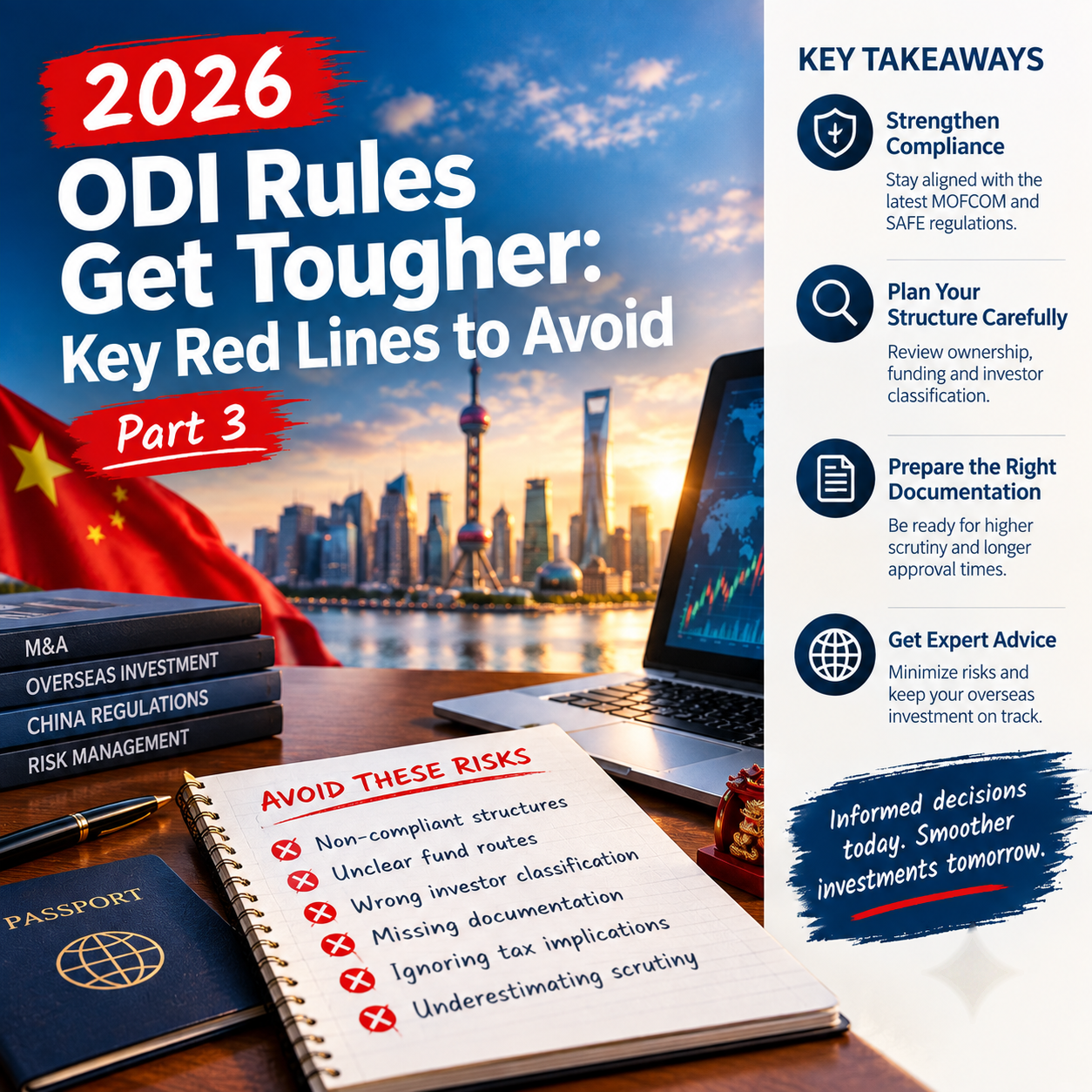
2026 ODI Rules Get Tougher: Key Red Lines to Avoid (III)
In the previous installment, we covered the basic legal definition of ODI, the statutory process, the six specific circumstances that require ODI filing, important clarifications on what does not require filing, and the legal, tax, and operational risks of failing to complete ODI filing. In this final section, we conclude with the mandatory eligibility criteria, the complete filing process, common rejection reasons and remediation, FAQs, and final recommendations.
Mandatory Eligibility Requirements for ODI Filing
Based on the joint review criteria of the three regulatory authorities and financial verification requirements, the domestic applicant enterprise must satisfy all of the following six mandatory conditions:
1. Eligible Entity Status:
The enterprise must be a business entity lawfully registered in China and must have been established for at least one year. For enterprises established less than one year, the ODI filing rejection rate approaches 100%. Sole proprietorships and domestic natural people are not eligible to apply for ODI filing.
2. Sound Financial Condition:
The enterprise’s audited financial statements for the most recent fiscal year must not show a net loss. Based on cross-border tax and practical experience, a return on net assets (RONA) of at least 5% is recommended. Financial data must be consistent and stable.
3. Reasonable Asset Structure, Avoiding “Small Parent/Large Subsidiary” Circumstances:
The enterprise’s debt-to-asset ratio should not exceed 70% (a debt-to-asset ratio exceeding 70% is a material risk indicator). The total amount of the proposed overseas investment must not exceed the total net assets of the domestic parent company. Circumstances where the parent company’s size is clearly insufficient to support the scale of the proposed overseas investment are strictly prohibited.
4. Genuine and Lawful Source of Funds:
The investment funds must consist of the enterprise’s own operating profits or compliant financing from regulated financial institutions. Supporting documentation, such as bank deposit certificates and lawfully executed financing agreements, must be provided. The capital chain must be fully traceable.
5. No Adverse Credit or Compliance History on the Part of the Investing Entity:
The enterprise’s equity structure must be clear, with no hidden nominee arrangements. The enterprise’s legal representative, its shareholders, and the enterprise itself must have no record of bad credit, no material tax violations, no foreign exchange violations, or other non-compliant conduct.
6. Genuine Commercial Substance of the Proposed Project:
The proposed investment must not involve a prohibited industry or a restricted/sensitive industry. The enterprise must have a complete business plan and a feasibility study report. Filings for shell investments or projects with no genuine operating plan will be rejected outright.
Complete ODI Filing Process
Legally Mandated Process:
- Internal Approval within the Company:
The board of directors or shareholders’ meeting must be convened to pass a formal resolution approving the overseas investment, clearly specifying the investment amount, target of investment, use of funds, operating plan, and other key information, which will serve as the foundation document for subsequent approvals.
- NDRC Filing/Approval:
Review of whether the project complies with national industrial policy and overseas investment plans. Pursuant to Regulation on Foreign Exchange Administration: For non-sensitive projects, if the amount of Chinese investment is less than US$300 million, the application is filed with the provincial-level NDRC for filing. If the amount of Chinese investment is US$300 million or more, or if the project involves a sensitive industry or a sensitive country, the application must be submitted to the NDRC at the central (national) level for approval, with a significantly extended review period.
- MOFCOM Filing:
Review of the enterprise’s eligibility, the lawfulness of its operations, and the compliance of the proposed investment. Upon approval, MOFCOM issues the Certificate of Overseas Investment for Enterprises.
- Foreign Exchange Registration:
Using the NDRC and MOFCOM filing/approval documents, the enterprise proceeds to its designated bank to complete overseas direct investment foreign exchange registration and obtain the foreign exchange business registration certificate, in accordance with the requirements of Notice on Issuing the Provisions on the Foreign Exchange Administration of the Overseas Direct Investment of Domestic Institutions.
- Capital Remittance and Overseas Registration:
After completing foreign exchange registration, the enterprise remits the investment funds overseas through lawful banking channels. Registration of the overseas company may be carried out concurrently with or after remittance; it is advisable to prepare the relevant incorporation documents for the target jurisdiction in advance.
Common Reasons for Rejection and Remedial Strategies
Six High-Frequency Reasons for Rejection:
- The investing entity does not satisfy the eligibility requirements: The enterprise has been established for less than one year; its net assets are insufficient; its audited financial statements for the most recent fiscal year show a net loss.
- Inadequate documentation of the source of funds: The capital chain is unclear; funds from personal accounts are commingled with enterprise funds; bridge financing is used for capital contribution.
- The target industry or destination is restricted: The investment is directed to a restricted/sensitive industry; the investment is directed to a country that does not have diplomatic relations with the PRC.
- The feasibility study report is inadequate: The report lacks supporting data, the commercial logic is incoherent, or the operating plan is unrealistic.
- Non-compliant overseas structure: The use of multiple layers of offshore entities, such as BVI or Cayman Islands entities, with no reasonable commercial justification.
- Basic documentation issues: Missing documents; missing signatures or seals; material inconsistencies in information across multiple documents.
Standard Remediation Steps After Rejection:
Analyze the Reasons for Rejection.
Rectify and Complete Basic Documentation.
Restructure the Project or Equity Structure.
Engage Professional Advisors to Re-file.
Frequently Asked Questions
Q1. Are sole proprietorships or domestic individuals eligible to complete ODI filing?
Pursuant to the Administrative Measures, ODI filing is available only to domestic corporate entities. Domestic natural people undertaking overseas investment are not subject to the ODI regime; they may use other lawful compliance pathways, such as the SAFE Circular 37 foreign exchange registration.
Q2. If I already have an existing overseas company that was established without completing ODI filing, do I need to do so retroactively?
Yes. Failure to complete ODI filing for historical overseas investments constitutes a non-compliant status. It is strongly recommended that enterprises engage cross-border compliance and tax advisors to conduct a comprehensive assessment and develop a remediation plan to avoid having such activities as the repatriation of overseas profits, equity transfers, and subsequent capital increases become completely impossible.
Q3. Does ODI filing apply to investments in Hong Kong companies?
Yes. Pursuant to Administrative Measures, domestic enterprises investing in Hong Kong, Macao, or Taiwan are subject to the same overseas investment regulatory requirements and must complete ODI filing.
Q4. Should an enterprise handle the application on its own or engage a professional agent?
The documentation requirements for ODI filing are complex, and the standards applicable to financial, equity, and project-related reviews are stringent. The rate of requests for supplemental documentation is high. For first-time applicants or those involving sensitive industries or complex structures, it is strongly recommended that enterprises engage a cross-border tax and compliance advisory firm with comprehensive capabilities to reduce the risk of errors and save time.
Q5. Does ODI filing, once completed, remain valid permanently?
No. Pursuant to dynamic regulatory requirements, enterprises must complete ODI equity registration reporting by June 30 of each year and must also submit monthly and annual reports to MOFCOM in accordance with its reporting requirements, as ongoing information disclosure obligations.
Conclusion
For enterprises expanding globally, compliance must come first, with tax considerations proceeding in parallel. ODI filing is the statutory prerequisite for domestic enterprises to make overseas investments and to transfer capital lawfully across borders. It is also a core prerequisite for overseas companies to open bank accounts, access equity financing, repatriate profits, and qualify for cross-border tax incentives.
With the full implementation of look-through regulations in 2026, the approach of relying on document packaging or shell structures is no longer viable. It is strongly recommended that enterprises, based on their own operational capabilities, financial condition, and industry positioning, plan their ODI filing strategies in advance, strictly comply with the two Administrative Measures, the Provisions, and other applicable laws and regulations, achieve full-dimensional compliance covering the investing entity, source of funds, and project, and at the same time, conduct proper cross-border tax structuring planning to reduce overall operational risk and tax burden.
If you are interested in this topic or if you have any related questions, feel free to contact us to discuss further.


