


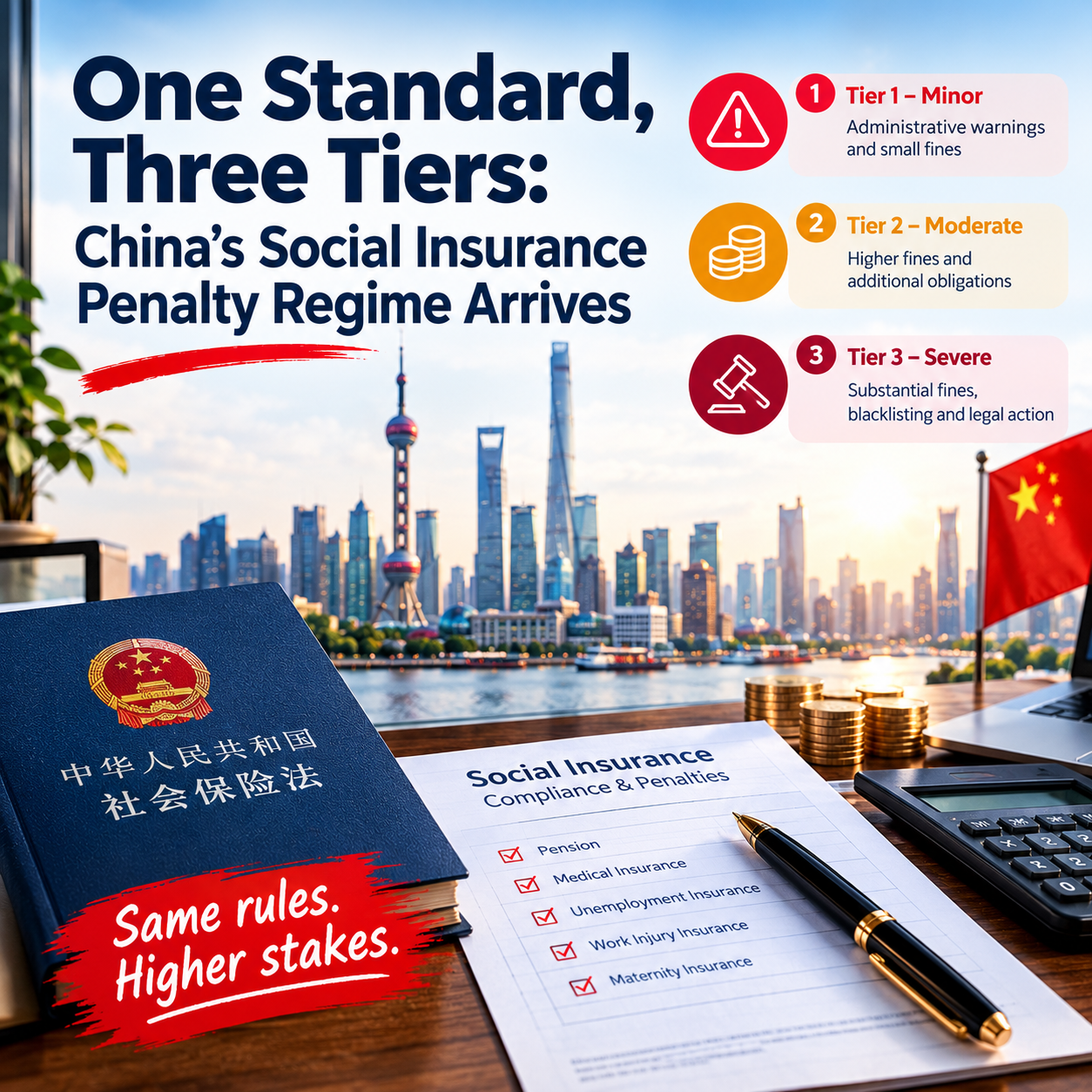
One Standard, Three Tiers: China’s Social Insurance Penalty Regime Arrives
On November 1, 2026, a seemingly technical tax document will quietly reshape social insurance enforcement in China.
The National Tax Administrative Penalty Discretionary Benchmarks (2026 Edition), issued by the State Taxation Administration (STA) as Announcement No. 20 of 2026, brings social insurance contribution underpayment under a unified national penalty framework for the first time, listed as Item 30 of the benchmarks . For foreign-invested enterprises employing local staff, this deserves careful attention.
But one clarification first: the “up to three times” penalty is not a new rule. It has existed in the Social Insurance Law since 2011. What the new benchmarks actually do is clarify, on a nationwide basis, when the penalty is one time, when it is two, and when it is three—replacing a patchwork of regional interpretations with a single enforceable yardstick .
Key Takeaway: The penalty rule was always there. What changes is that tax authorities, now acting as social insurance collectors, will apply a nationally consistent three-tier calculation rather than divergent local practices.
I. The Three Tiers: Amount and Ratio Together Determine Severity
Under Item 30 of the Benchmarks, where an employer fails to pay or underpays social insurance contributions and remains non-compliant after being ordered to rectify within a prescribed period, the penalty is calculated as follows:
| Tier | Conditions | Penalty Range |
|---|---|---|
| 1 | Underpayment below RMB 500,000; or RMB 500k–5M with a shortfall ratio below 30% of total payable | 1× the underpaid amount |
| 2 | RMB 500k–5M with ratio exceeding 30%; or above RMB 5M with ratio below 30% | 1–2× the underpaid amount |
| Above RMB 5M with ratio exceeding 30% | 2–3× the underpaid amount |
A CCTV example illustrates the stakes: a company with RMB 6 million in underpaid contributions, representing 35% of its total social insurance liability, falls into Tier 3—exposing it to a maximum fine of RMB 18 million, plus daily late fees of 0.05%.
The logic is deliberate: the larger the shortfall and the higher its proportion of total liability, the heavier the penalty. For employers that have long declared contributions at the minimum base while actual wages were significantly higher, accumulated shortfalls can push them into the upper tiers.
II. A Procedural Safeguard: Penalties Are Not Automatic
A critical detail often lost in headline coverage: penalties do not trigger upon discovery alone.
Professor Shi Zhengwen of China University of Political Science and Law explained in a CCTV interview that the collecting authority must first issue a rectification order with a deadline. Only if the employer fails to comply after that deadline does the penalty process begin.
This pre-procedural step reflects a “strict but proportionate” enforcement philosophy: employers are given an opportunity to correct, while persistent non-compliance faces meaningful consequences. For businesses facing temporary cash-flow difficulties or administrative oversights, prompt payment within the rectification window can avoid fines altogether.
III. “Voluntary Waiver” Agreements: A Legal Fact Worth Restating
Alongside the penalty benchmarks, another issue has drawn attention: the validity of “voluntary waiver of social insurance” agreements between employers and employees.
Such agreements are void from the outset. Article 4 of the Social Insurance Law states: “Employers and individuals within the territory of the People’s Republic of China shall pay social insurance contributions in accordance with the law.” The obligation is statutory and mandatory—not a benefit that can be negotiated away.
Professor Shi Zhengwen stated plainly that such agreements “violate mandatory provisions of law” and are invalid; employers cannot use them to escape their statutory contribution obligations.
For foreign employers, this point must be aligned across management and HR: there is no “flexible arrangement” space in social insurance compliance. Any attempt to contract around the obligation not only fails to provide protection in enforcement proceedings but may also become adverse evidence in a labour dispute.
IV. Practical Implications for Foreign-Invested Enterprises
4.1 Reassessing “Hidden Risks” in Social Insurance Compliance
Many foreign enterprises face a practical question: must foreign employees participate in China’s social insurance system? Under current rules, foreign nationals legally employed in China are required to participate. In the past, some companies may have used offshore compensation arrangements or commercial insurance substitutes. With unified national benchmarks in force, the interaction between social insurance compliance reviews and the tax collection system will become tighter.
4.2 The Cumulative Effect of Historical Underpayment
The benchmarks calculate penalties based on “the underpaid amount,” which is a cumulative historical figure. If a company has declared at the minimum base for several years while actual wages were substantially higher, the accumulated shortfall upon a rectification order may reach Tier 2 or even Tier 3. The combined impact of back payments plus penalties on cash flow warrants advance assessment.
4.3 A Relative Advantage for Compliant Employers
Professor Shi also noted that unified benchmarks “protect not only employees’ rights but also the interests of compliant enterprises.” When enforcement standards are consistent nationwide, companies that have contributed in full no longer face the unfair competitive disadvantage of underpaying peers. Over the long term, this supports a more predictable employment environment.
V. Recommended Actions
Before November 1, 2026:
- Verify that current contribution bases align with actual wages
- If historical discrepancies exist, estimate potential back payments and cash-flow impact
- Eliminate any “voluntary waiver” agreements or similar arrangements
Medium term:
- Integrate social insurance compliance into joint finance-HR control processes
- Review compensation structures involving foreign employees to confirm contribution arrangements comply with current rules
Long term:
- Monitor the trend of integrated tax and social insurance collection; incorporate social insurance costs into total employment cost models
- Build compliance adjustment buffers into annual budgets
Conclusion: The Value of a Unified Yardstick Is Predictability
The 2026 Benchmarks are not a “new policy” but a standardisation of enforcement. They take a penalty written into law in 2011—but long subject to inconsistent application—and place it on a quantifiable, predictable footing.
For foreign enterprises operating in China, this means less room for error in social insurance compliance, but also clearer rules. Calibrating early is far more comfortable than responding late.
If you have any further concerns, contact us .


