


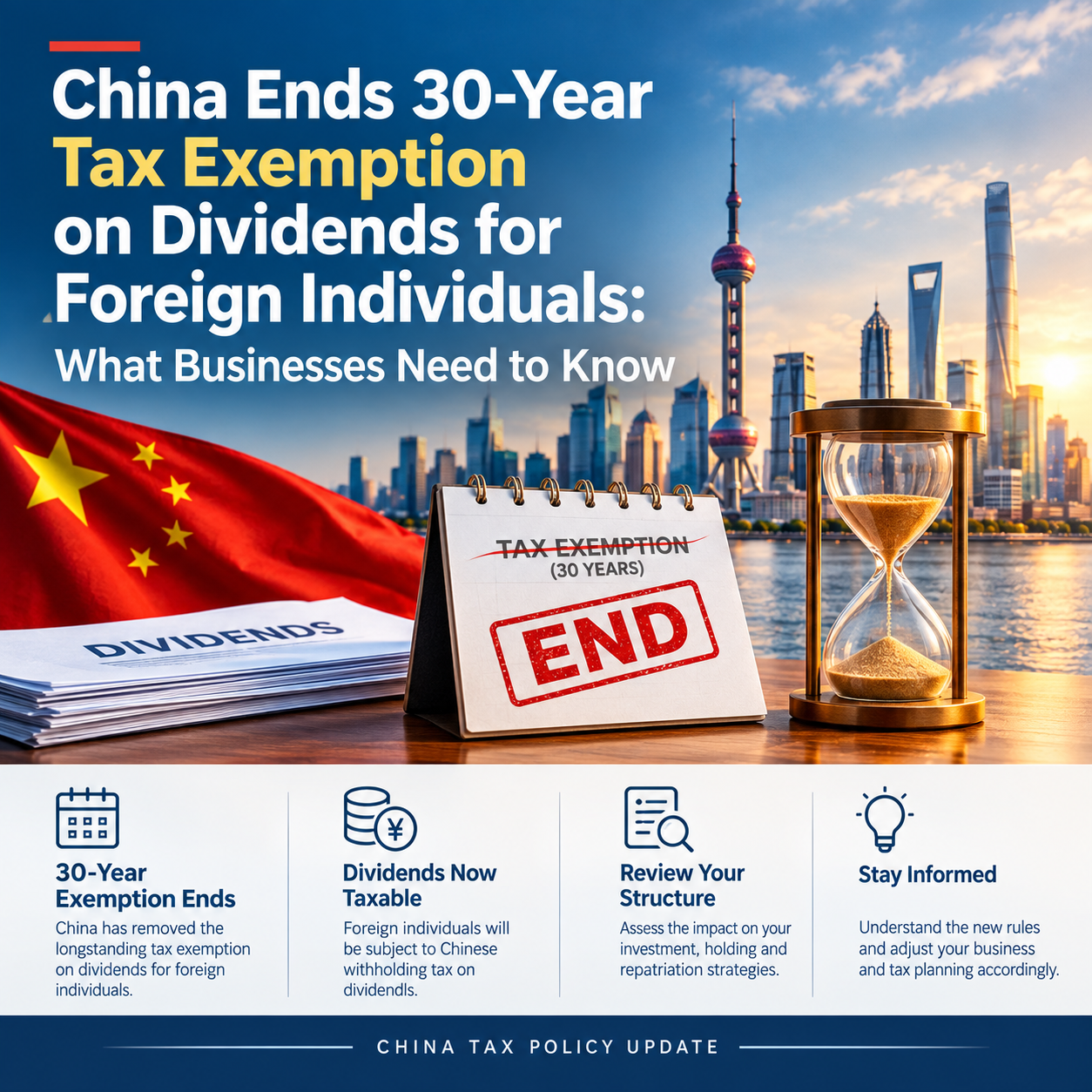
China Ends 30-Year Tax Exemption on Dividends for Foreign Individuals: What Businesses Need to Know
On September 1, 2026, China’s Ministry of Finance and the State Taxation Administration issued Announcement on Matters Concerning Individual Income Tax Policies for Dividends Received by Foreign Individuals, bringing an end to a long-standing tax benefit that has been in place since 1994.
Effective immediately, foreign individuals receiving dividends and bonuses from foreign-invested enterprises (FIEs) in China are now subject to 20% individual income tax (IIT) on such distributions.
This is a significant policy shift — and one that all internationally active businesses with expatriate shareholders or senior executives holding equity stakes should understand.
What Has Changed?
Before September 1, 2026
Foreign individuals were temporarily exempt from IIT on dividends and bonuses received from FIEs, under the now-repealed Article 2(8) of Notice on Certain Policy Issues Regarding Individual Income Tax, issued in 1994.
From September 1, 2026
The exemption is repealed. Foreign individuals must now pay IIT at the standard 20% rate on dividend and bonus income from FIEs.
Key Compliance Requirements
| Obligation | Responsibility | Deadline |
|---|---|---|
| Tax withholding | FIE paying dividend | By the 15th of the month following payment |
| Tax return filing | FIE (withholding) | By the 15th of the month following payment |
| Self-declaration (if FIE fails to withhold) | Foreign individual | By June 30 of the year following income receipt |
Important: If the FIE fails to withhold the tax, the foreign individual should self-declare and pay by June 30 of the following year. However, if the tax authority issues a specific deadline, that deadline must be met.
Why Did China Make This Change?
This reform reflects the evolution of China’s economic environment. The 1994 exemption was designed to attract foreign investment during a critical phase of opening-up. Today, the policy rationale has shifted:
- Tax fairness: Under the old rules, foreign investors received tax-free dividends while domestic investors paid 20% IIT on the same income.
- Closing loopholes: The exemption created potential for tax avoidance, especially where cross-border arrangements could exploit the difference in treatment.
- Alignment with international norms: Major economies generally apply worldwide income taxation to their residents. The exemption effectively shifted tax revenue from China to investors’ home countries without reducing actual tax burdens.
The Critical Point: Actual Tax Burden Likely Unchanged
This is the point that matters most about business communication.
For many foreign investors, the actual tax burden will not increase. Here’s why:
Most European and American countries operate a worldwide income taxation system. Under the previous exemption, a foreign individual who received tax-free dividends in China would still owe tax to their country of residence on that income. The exemption meant China collected zero tax, but the investor’s home country would compare the tax rate in accordance with the tax treaty if any and then collect the difference when it occurs.
Bottom line: Although taxes are levied in China rather than overseas, the overall tax burden for investors from countries that have signed tax treaties with China and have a foreign tax credit mechanism in place may remain unchanged.
What This Means for China’s Investment Climate
This policy shift is not about making China less attractive to foreign investors. It’s about aligning tax treatment with modern economic realities and treating all investors equally under the tax system.
As experts note, foreign investment decisions are increasingly driven by:
– China’s vast consumer market
– Comprehensive industrial systems
– World-class infrastructure
– High-quality labour resources
– Continuously improving business environment
Tax exemptions are now one factor among many — and tax fairness ultimately supports a healthier long-term investment climate.
Next Steps for Your Organization
1. Audit your next dividend payment: If your FIE is due to declare or distribute dividends, assess the new tax obligation.
2. Update shareholder communications: Inform foreign individual shareholders of the withholding requirement before distributions are made.
3. Consult your tax advisor: Verify how the 20% Chinese IIT interacts with your home country’s tax system and relevant double taxation agreements.
4. Monitor further guidance: The tax authorities may issue implementation rules or interpretations — stay informed.
If you have any questions, feel free to contact us to discuss further.


