China’s New Exit & Entry Administration Rules: Escalated Compliance Risks for Visas and Work Permits
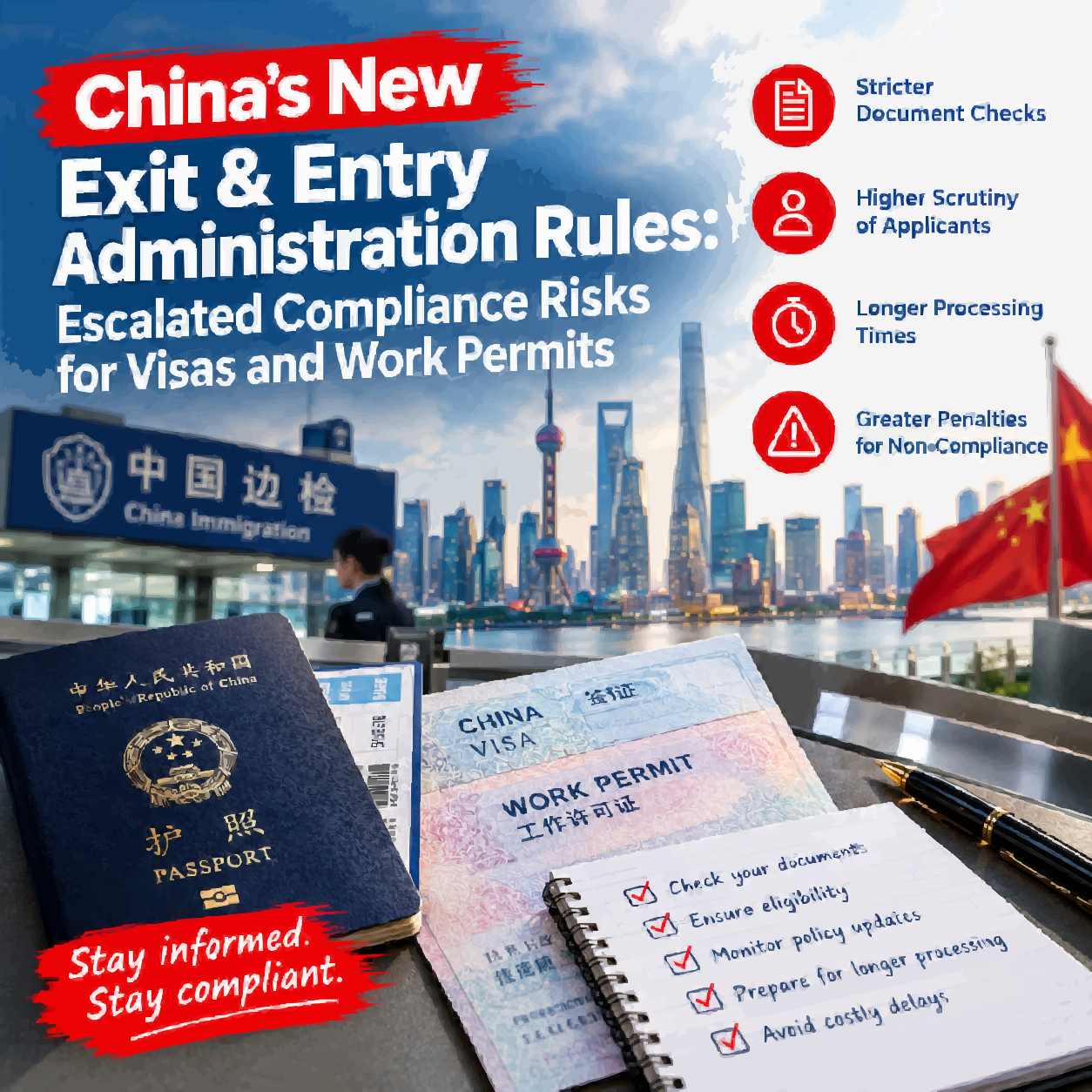
China’s newly issued Provisions of the State Council on Exit and Entry Administration (the Provisions) took effect on 15 September 2026. Comprising 19 articles, this regulation standardises exit and entry procedures, strengthens authorities’ power to verify identity and the genuine purpose of travel, and tightens oversight over immigration intermediary services.
For multinational employers, HR teams, global mobility managers and foreign employees, the new rules materially raise requirements for documentation, factual verification and immigration compliance — particularly for visa applications, work permits and residence permits.
The regulation does not replace the existing Exit and Entry Administration Law of the People’s Republic of China. Instead, it reinforces enforcement of the existing statutory framework by imposing clearer accountability on applicants, inviting entities and immigration service providers. Foreign companies deploying expatriates to China, hosting frequent business visitors or renewing existing foreign staff permits should immediately review their internal immigration workflows, as previously accepted informal practices now carry substantially higher legal and business risks.
1.Core Principle: Applications Must Be Based on True and Lawful Purposes
Article 3 sets the foundational rule for all exit, entry, stay and residence applications:
Persons applying for exit, entry, stay or residence shall have a true and lawful cause for application. When verifying the identity and application purpose of exit and entry persons, immigration authorities and visa authorities may inquire about relevant matters and require presentation of documents, materials, electronic data and other information. Exit and entry persons shall cooperate. Entities or individuals issuing invitation letters or other application materials for exit and entry persons shall be responsible for the authenticity of the invitation content and certified matters, and cooperate with immigration authorities and visa authorities to verify relevant information. Where exit and entry persons provide false materials or make false statements, immigration authorities and visa authorities have the power to refuse to issue exit/entry documents or deny exit or entry.
This provision eliminates the long-standing tendency among many companies to treat invitation letters, business visa applications and work permit filings as routine administrative formalities. Any employer or organisation issuing an invitation letter now bears direct accountability to substantiate the accuracy of all statements contained within it and must cooperate with official verification requests.
The highest risk scenario for foreign organisations remains a mismatch between the stated visa purpose and actual on-site activities. Using an M business visa for paid, formal long-term employment without a valid work permit constitutes unauthorised employment and a material visa-purpose mismatch. All supporting materials must be consistent: job titles, salary information, employer particulars and intended activities must align across HR records, employment contracts, invitation letters, work permit submissions and visa application forms.
2.Penalties for False Declarations and Immigration Violations
Article 5 specifies punitive consequences for applicants who misrepresent information:
Where a foreign national provides false materials or makes false statements when applying for a Chinese visa overseas or applying for entry at a port, immigration authorities and visa authorities may decide to bar such foreign national from entering China for 1 to 5 years. Where a foreign national receives criminal punishment for obstructing national border administration, or administrative penalty for defrauding exit/entry documents or illegal entry and exit, immigration authorities may decide to bar entry for 1 to 5 years upon completion of penalty execution, subject to other provisions of law.
For dispatched executives, entry bans carry long-term operational consequences. A multi-year entry restriction can disrupt board meetings, investment site visits, project delivery and regional leadership assignments. Non-compliance risk is not limited to deliberate fraud; inconsistencies across application documentation may trigger extended official scrutiny.
3.Regulation of Immigration Intermediaries and Vendor Due Diligence
Articles 8 and 13 impose restrictions on immigration intermediary services:
Overseas enterprises and institutions shall not provide exit and entry intermediary services within the territory of China. Institutions engaged in exit and entry intermediary services shall not provide or assist in providing false materials, or assist others in handling exit/entry documents or procedures in violation of regulations.
Immigration service providers operating in China should complete mandatory registration with local immigration authorities. Registered intermediaries are prohibited from false advertising, submitting falsified documents or assisting clients to improperly obtain visas and permits.
4.Practical Compliance Action Plan
Companies with foreign staff, upcoming business travel or pending work permit & visa applications should launch a targeted compliance review before the next application or renewal cycle. Recommended actions:
- Audit active and pending permit cases. Cross-check visa, work permit and residence permit applications for consistency against employment contracts, salary records and formal job descriptions.
- Strictly separate genuine business travel from employment activities. Confirm M visa visitors do not perform paid work or deliver services that legally require a Z visa, Foreigner’s Work Permit and residence permit.
- Strengthen invitation letter governance. Implement formal internal sign-off workflows, verify all visitor information, and retain audit-ready evidence confirming visitor identity, itinerary, business purpose and corporate relationship.
5.Wider Business Thoughts
This new exit-entry framework expands government authority to manage the entry and stay of foreign nationals, raising compliance stakes for multinationals operating in China or sending personnel to the country. The rules are rolled out amid a broader landscape of intensified corporate compliance scrutiny across China, covering corporate taxation, anti-money laundering, cross-border data transfer and invoice management. Immigration compliance should no longer be treated as an isolated HR function; it must be integrated into the organisation’s full China compliance programme.
Companies with prior informal arrangements, such as short-term consultants performing work under business visas, should conduct remedial reviews immediately. Historic non-compliance may be uncovered during future permit renewal or official inspection rounds. Unaddressed violations may result in corporate penalties, entry restrictions for key talent, and reputational harm for the China subsidiary.
VISA-FREE
One frequent misconception among foreign nations relates to visa-free entry. Many foreign nationals mistakenly assume they can enter China under the unilateral visa-free programme and then seek employment locally after arrival. This practice is explicitly not permitted.
Under China’s unilateral visa-free scheme, holders of valid ordinary passports from 50 eligible countries may enter China without a visa for business visits, tourism, family visits, exchanges or transit, for a maximum continuous stay of 30 calendar days. The 30-day period starts from the day after entry.
The eligible nations include most European countries: France, Germany, Italy, Spain, the Netherlands, Switzerland, Ireland, Hungary, Austria, Belgium, Luxembourg, New Zealand, Australia, Poland, Portugal, Greece, Cyprus, Slovenia, Slovakia, Norway, Finland, Denmark, Iceland, Andorra, Monaco, Liechtenstein, the Republic of Korea, Bulgaria, Romania, Croatia, Montenegro, North Macedonia, Malta, Estonia, Latvia, Japan, the United Kingdom, Sweden, Canada and Russia, alongside Brunei, Saudi Arabia, Oman, Kuwait, Bahrain and five South American nations (Brazil, Argentina, Chile, Peru and Uruguay).
Crucially, work, study and journalistic activities are excluded from visa-free eligibility. The visa-free status only authorises the limited activities listed above. Any foreign national entering visa-free with the hidden intention to secure a job and work in China would be making a false representation of entry purpose, triggering the verification and penalty provisions under Article 3 and Article 5 of the provision. Border officials may deny entry at the port if they identify that the applicant’s real objective is job hunting or employment. Even if admitted, any subsequent work undertaken during the visa-free stay constitutes illegal employment under the Exit and Entry Administration Law of the PRC. Article 41 of this law states: Foreigners who work in China shall obtain work permits and work-type residence permits in accordance with relevant regulations. No entities or individuals shall employ foreigners who have no work permits or work-type residence permits.
Validity Period of the VISA-FREE Policy
The policy – according to the FAQs on Visa-free Entry into China (published on 7th of July 2026) – has different expiry timelines for different nationalities (official information released by China’s Ministry of Foreign Affairs):
- Brunei: Visa-free entry has no fixed expiry date;
- Russia: Visa-free scheme is valid until 31 December 2027;
- The remaining 48 eligible countries (including most European states listed above): Visa-free arrangement is valid until 31 December 2026.
Whether this policy will be extended in the future remains to be seen, and we will need to monitor documents issued by the Ministry of Foreign Affairs and various government departments.
Conclusion
The provisions marks a clear tightening of China’s immigration regime, shifting official focus to substance, factual consistency and documentary auditability. The core takeaway for European management teams: authorities will actively verify whether the stated purpose of a visa or work permit application matches the applicant’s actual role, activities and supporting evidence.
Organisations that systematically audit immigration files, strengthen invitation letter controls, and align HR, legal, tax and global mobility teams will be best positioned to avoid application refusals, administrative delays, illegal employment penalties and reputational risk.
If your company is deploying expatriates to China or reviewing existing foreign staff arrangements, contact us for a tailored compliance assessment.