


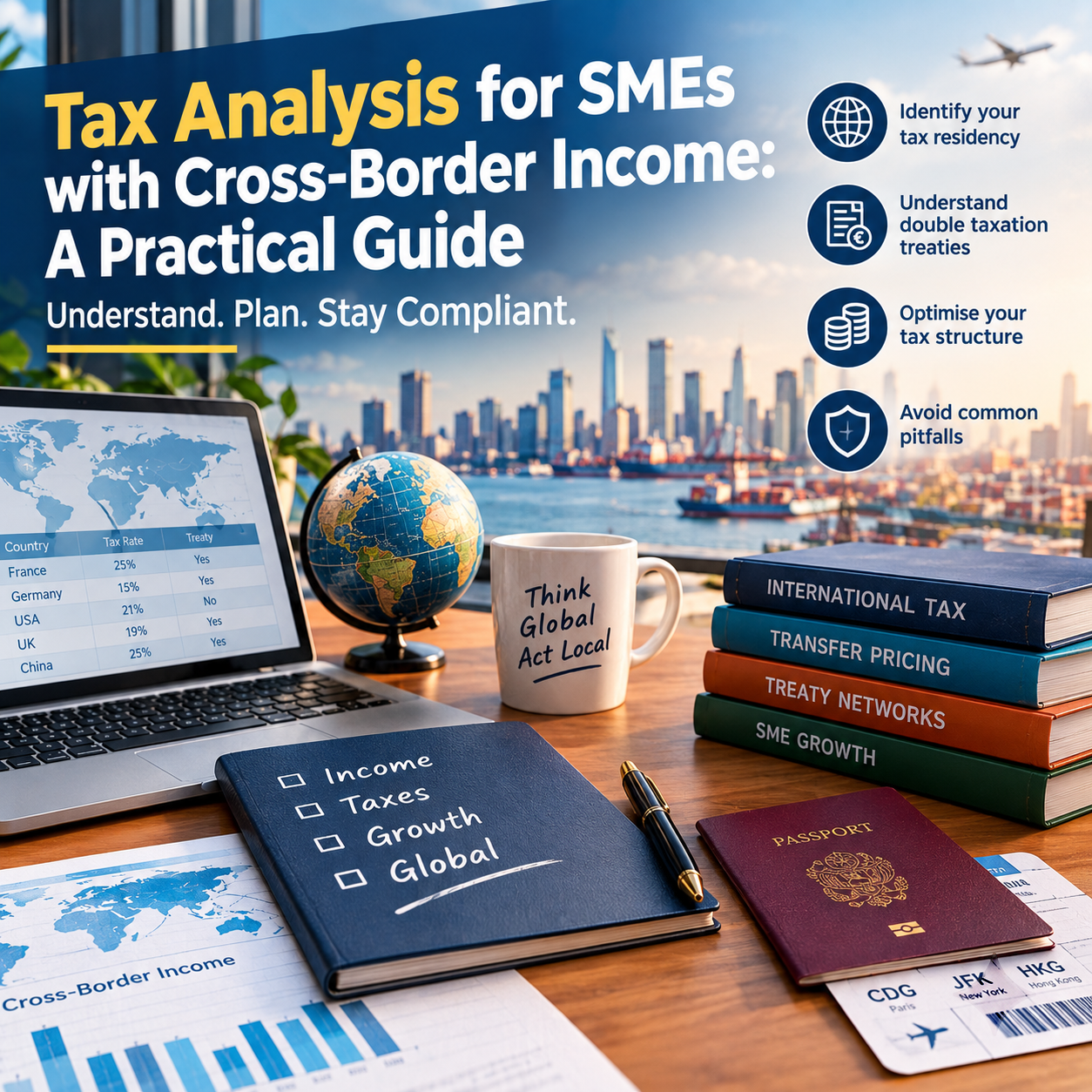
Tax Analysis for SMEs with Cross-Border Income: A Practical Guide
Driven by the Belt and Road Initiative and globalization, small and medium-sized enterprises (SMEs) are increasingly embedded in international supply chains. Many Chinese SMEs now collaborate closely with foreign companies, generating revenue through a variety of cross-border activities, including goods exports, services (such as software outsourcing and design consulting), royalty payments, and overseas investment dividends.
However, these enterprises often face significant tax-related challenges. High compliance costs, unfamiliarity with international tax rules, and the risk of double taxation or inadvertent tax leakage are common pain points. This article breaks down the key tax considerations, VAT, corporate income tax, and stamp duty to help SMEs navigate their obligations and avoid unnecessary tax burdens.
1. Value-Added Tax (VAT) – Cross-Border Exemptions and Classification
Under the “Measures for the Implementation of the Pilot Program of Replacing Business Tax with VAT” (CaiShui [2016] No. 36, Appendix 4) and subsequent policies, certain cross-border taxable activities may qualify for zero-rating or VAT exemption. Specifically:
• International transportation services
• Research and development services provided to overseas entities
• Design services fully consumed outside China
These services are exempt from VAT, but the associated input VAT on costs (e.g., purchased equipment or services) cannot be deducted.
Key Condition: “Fully Consumed Outside China”
For a service to qualify, all three of the following must be satisfied:
1. The service recipient is located outside China.
2. The service is actually used outside China.
3. The service is unrelated to goods or real estate located within China.
Common Mistake: Many SMEs assume that “the client is overseas” automatically qualifies for exemption. This is not correct. If the service is substantively tied to domestic assets or activities in China, VAT applies.
• ✅ Eligible Example: A Chinese company provides a US client with a market research report on the US market.
• ❌ Not Eligible: A Chinese company provides a foreign-invested enterprise in China with market research on the Chinese local market. This would be subject to VAT.
Another Example: A Chinese company provides cloud services to a German client, but all servers and storage facilities are located in China. Even though the revenue comes from abroad, the service is actually rendered in China, so the VAT exemption does not apply.
2. Withholding Corporate Income Tax (CIT)
When a Chinese SME receives income such as dividends, interest, royalties, or rental payments from a foreign enterprise (a non-resident enterprise), the foreign payer is often required to withhold corporate income tax at source. This is commonly referred to as withholding tax (WHT).
Typically, when a foreign enterprise pays for services to a Chinese SME, the local tax authority in the foreign country may retain a portion of the CIT. The rate generally ranges from 5% to 20%, with 10% being the most common.
Tax Credit Mechanism
Under Double Taxation Agreements (DTAs), Chinese SMEs can claim a foreign tax credit in China for the withholding tax paid overseas. The credit is limited to the amount that would have been payable in China on the same income.
Credit Limit Formula:
Limit = Total Chinese CIT liability (on worldwide income) × (Foreign-source taxable income ÷ Total worldwide taxable income)
The actual credit allowed is the lower of:
• The foreign tax actually paid
• The calculated credit limit
If the foreign tax paid exceeds the limit, the excess can be carried forward for up to 5 years.
3. Stamp Duty on Cross-Border Contracts
SMEs must also consider stamp duty on overseas business contracts. This applies to contracts that are:
• Signed, received, or used within China, or
• Signed outside China but used within China
Both paper and electronic contracts are subject to stamp duty. Common rates include:
| Contract Type | Rate |
|---|---|
| Sales/purchase contracts (export) | 0.03% of contract value |
| Technology contracts (R&D/consulting) | 0.03% of contract value |
| Loan agreements (cross-border) | 0.005% of contract value |
Note: Stamp duty is often overlooked. SMEs should maintain a clear contract register to ensure compliance.
4. Case Study
Background
Shanghai XX Tech Co., Ltd. (SME, VAT general taxpayer) had the following cross-border transactions in 2026:
• Service export: Provided ERP maintenance services to an Indian client, fully consumed outside China. Contract value: RMB 1,000,000 (excluding VAT).
• The Indian client withheld RMB 100,000 in local corporate income tax at source.
Tax Calculation and Analysis
1) VAT Treatment
The service qualifies as “fully consumed outside China,” so it is VAT-exempt.
• VAT payable: RMB 0
• However, input VAT on servers purchased exclusively for this project is not deductible.
2) Corporate Income Tax (CIT) Credit
Assume:
• Total taxable income (domestic + foreign): RMB 3,000,000
• Total annual revenue: RMB 10,000,000
• Foreign-source taxable income: RMB 1,000,000
Credit limit calculation:
Limit = RMB 3,000,000 × (RMB 1,000,000 ÷ RMB 10,000,000) × 25% = RMB 75,000
Actual foreign tax paid: RMB 100,000
Allowable credit: Lower of the two = RMB 75,000
3) Stamp Duty
• Contract type: Technology service agreement
• Contract value: RMB 1,000,000
• Rate: 0.03%
Stamp duty payable = RMB 1,000,000 × 0.03% = RMB 300
5. Practical Recommendations for SMEs
1. Maintain a “Cross-Border Income Ledger” — Track tax credits by country and leverage the 5-year carryforward mechanism.
2. Review contracts carefully — When signing cross-border agreements, include gross-up clauses to clarify which party bears the withholding tax. This helps protect your profit margins.
3. Avoid common VAT pitfalls — Just because your client is overseas does not automatically mean the service is exempt. Ensure the service is actually consumed abroad.
4. Don’t overlook stamp duty — Even if a contract is signed abroad, if it is used in China, stamp duty may still apply.
5. Seek professional advice — International tax rules are complex and vary by jurisdiction. Consulting a tax specialist familiar with DTAs and local regulations is strongly recommended.
This article is intended for informational purposes only and does not constitute tax or legal advice. Please consult us for specific guidance to your situation.
If you are interested in this topic or if you have any related questions, feel free to contact us to discuss further.


